In Schenectady, New York, 1986 was not a very good year. It seemed fitting that, on November 22, while marching in the pre-Christmas Parade at a local Shopping Mall, Santa Claus suddenly keeled over, felled by a fatal heart attack. (1)
Just a couple of miles away, the works of Schenectady's biggest local employer, known sarcastically as Generous Electric, was in the midst of its own corporate coronary. In January, the top GE area executive had warned that job reductions would number "at least" 1500. That "at least" sounded ominous, even in a city where jobs had been leaking away by the hundreds for decades. It soon became apparent that the number would be a lot larger. On November 17, some 800 members of Local 301 of the International Union of Electrical Workers (IUE) marched on Schenectady's city hall to protest the 3000 most recent layoffs that were reducing the initial 13,000 work force by 23%. (2)
The workers chanted such slogans as, "Here lies motors, here lies gas. GE kiss my ass". The references were to the Large Motor and Generator Business, the Schenectady Works' initial and oldest business, which was to be shut down, and to Gas Turbine, the Works' youngest and most promising business, which was completing a move to South Carolina. Schenectady 's mayor, who had herself married a scientist at General Electric's nearby Research Lab, met with the marchers, sympathized, but could do nothing. Next to the entrance to that Schenectady City Hall stood a recently installed stone slab celebrating "General Electric 's 100 years in Schenectady". An observer noted that the slab was looking more and more like a tombstone.
Those worst of times in Schenectady and at its General Electric Works were, however, the best of times at GE's Fairfield, CT corporate headquarters. The opening lines of the company's 1986 annual report proclaimed that
By any measure 1986 was a strong year for your Company — record sales, record earnings, several successful acquisitions and excellent positioning for the future.
That report went on to describe two of those 1986 acquisitions, each among the largest in the company's history. They brought in RCA, including its NBC television network, and an old and well known investment house, Kidder Peabody. None of that old electric stuff here! What was here was less clear. The most frequent label applied in 1986 by outsiders to General Electric was "conglomerate". The company's management disliked that description. It preferred "the New GE." At the conclusion of that 1986 Annual Report, that New GE was described in a summary most notable for the absence of that now unnecessary word "electric".
In summary, GE is a unique set of different businesses, run by a unique group of people with different talents — united by the company's shared values and strengthened by its human, technical, and financial resources. Whether it is Financial Services' ability to adapt to its market environment, or Medical Systems' technology leadership, or Aircraft Engines' and Plastics' use of creative alliances.
The New GE could have said, echoing the fictional movie star Norma Desmond, "I'm still big. It's electricity that got small".
Leading the New GE in 1986 was a small man who had got very big. Jack Welch had been educated as a Ph.D. Chemical Engineer. On joining GE, however, he quickly expanded beyond technology, training himself in management, manufacturing, finance and sales. He did so not by reading the company's management instructional "Blue Books" or attending its business school in Crotonville NY . He learned how to manage by leading one of GE's major business successes, its plastics business. He was now, in 1986, the scourge of the Old GE. His layoffs earned him the nickname Neutron Jack (like the Neutron Bomb, kills the people but spares the buildings.) This was inaccurate. In Schenectady at least, he was destroying the buildings too.
This is a story of how the Old GE got from its prehistoric origins in 1886 to its renewal in 1986, from its progenitor Thomas Edison to its renewer Jack Welch. Telling this story has two purposes. One is to answer some specific questions about the Old GE. Why was it born? Why did it thrive for a span not terribly different from the length of a human life? Why did it end suddenly, replaced by a New GE?
Beyond those specific questions, there is a general historical issue that the story of the Old GE illuminates. That issue is the role played in the U.S. economy by Giant Corporations. Identifying those Giant Corporations begins with a question. What is a corporation? A corporation is a business collectively owned by stockholders. It is chartered by a government (in the U.S., by one of the 50 states). It possesses special rights granted through that charter, such as limited liability of those stockholders for the debts of the corporation. Also through that charter, a corporation can exercise many, though not all, of the legal rights of a person. Instead of further explaining those features, this book focuses on an old folk-definition. A corporation is a giant immortal artificial person without an ass to kick or a soul to save.
If a corporation is already a giant, what is a Giant Corporation? Here that term identifies a U.S. corporation that consistently throughout the 20th century appeared in one of the top 25 spots on the Fortune 500 list of largest U.S industrial companies or similar retrospectively compiled rankings covering the pre-Fortune years. Examples of those 20th Century Giants include AT&T, DuPont, Exxon, Ford, General Motors, Proctor and Gamble, U.S. Steel and General Electric. (3)
Those Giant Corporations were typically ten times as big (measured, for example, by annual sales) as the Very Big Corporations occupying the next 100 or so places on such a top 500 list. The Giants were 30 times or more as big as the Merely Big Corporations occupying the remaining few hundred places.
In the the 20th century those Giant Corporations typically grew much faster than the U.S. GDP. Measured in current dollars, GE, for example, a company with approximate sales (measured in current dollars) of $13 million in the year of its founding 1892 grew by the year 1986, the year the Old GE gave way to the New, to sales of $36 billion (also in current dollars), This is a multiple of about 2800. Over that same time span, the U.S. Gross Domestic Product, GDP, (also measured in current dollar terms) grew from about $17 billion to about $4.6 trillion, a multiple of only 270. In that year of 1986 the dollar value GE delivered to the U.S. economy was nearly one half a percent of the U.S. GDP. In other words, just 200 companies the size of GE could have produced the entire U.S. GDP. (Details of GE's numerical performance are in Appendix 1, The Old GE by the Numbers).
What ought one to think about the Old GE and its fellow Giants? Even after more than a century of arguing, Americans are not sure. One 21st century book on Giant U.S. Corporations, by law professor Tim Wu, condemns The Curse of Bigness. Another, by two professors of public policy, Michael Lind and Robert D. Atkinson, proclaims that Big is Beautiful. (4)
What have historians said about the emergence and historical significance of Giant Corporations? One historian in particular has dominated the answering of that question. Alfred DuPont Chandler presented an extremely influential interpretation of the rise of Giant Corporations in three major books: Strategy and Structure (1962), The Visible Hand (1967) and Scale and Scope (1990). With those books, Chandler achieved a market dominance in the field of business history that the corporate giants he studied might well have envied.
Chandler's interpretation viewed those 20th Century Giant Corporations as neither curses nor things of beauty. Instead, he implicitly viewed them as generally beneficial, and explicitly declared them inevitable. That inevitability, he said, flowed from the previous 19th century arrival of such technologies as the steam engine, mass produced steel and chemicals, machine tools, fossil fuel extraction, railroads, and the telegraph. These enabled the assembly of raw materials, energy, and information on a vastly greater scale than had ever before been possible. These bigger companies ran bigger machines in bigger factories producing high volumes of products. This larger scale paid off only in a minority of industries. It was, however, an important minority. Examples were telephony, chemicals, oil, automobiles, soap, steel, and electricity. In those industries grew Giant Corporations including AT&T, Exxon, Ford,General Motors, Proctor and Gamble, U.S. Steel and General Electric.
As scale increased, it became increasingly costly for those Giant Corporations to let a significant portion of their expensive productive capacity lie idle. A solution was to broaden scope; that is, to diversify into new product lines that used existing productive capacity and human skills. For the Old GE, for example, the following 20 examples illustrate the breadth of that scope expansion. They are, in alphabetical order, advanced materials, aerospace equipment, aircraft engines, appliances, computers,controls, electronics, finance, generators, housewares, information services, lamps, locomotives, medical diagnostic equipment, motors, nuclear reactors, radios, ship drives, televisions, turbines, and weapons. The natural growth of these diversifications is here depicted in a visual metaphor called the Edison Elm.
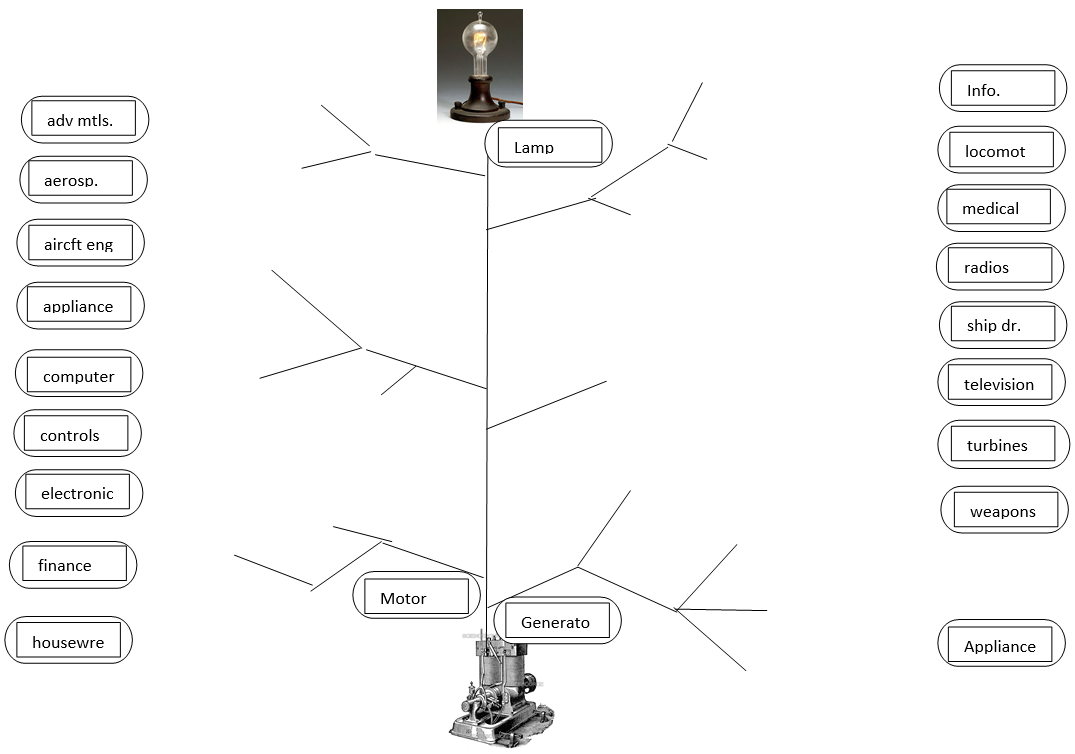
The elm is depicted schematically, from its root in the electrical dynamo, to its crown the light bulb. Its trunk is the electrical equipment need to connect those two original elements. Some branches are nearer the root, some nearer the crown, some in the middle. The places of three of the earliest product "leaves", lamps, motors and generators, are indicated. The reader is invited to play a game of pin the leaf on the elm, and place the leaves for the other 17 diverse products where they branch off the tree. The answer is on page 411.
Another key element of Chandler's interpretation addressed control over that scale and scope. In the 19th century, production quantities and prices were mainly determined by the market. For the vastly greater scale and scope of the new Giant Corporations, market signals no longer sufficed. Control had to be exerted from inside the corporation, by its management. Chandler expressed this change by updating an earlier metaphor coined by Adam Smith. Around the turn of the 20th century, Chandler said, Smith's Invisible Hand of the market was replaced by the Visible Hand of professional managers.
The above is a very condensed summary of the Chandler interpretation. Since its introduction a half century ago, it has been amended and improved by other historians.
For example, economic historian Naomi Lamoreaux noted that Chandler went too far in attributing the emergence of the giants to the rational, technocratic strategizing of that new breed of professional managers. Some giants, such as U.S. Steel and GE, were instead the product of mergers executed by the old breed of financiers on Wall Street. (5)
Another limitation was pointed out by historian Stephen Maher. He argued that Chandler understated the role of the U.S. Federal Government in promoting corporate giantism. Government is often depicted as the corporation's enemy through its antitrust laws and other regulations. Arguing to the contrary, Maher depicts the Federal government and giant corporations as capitalist co-conspirators. (6)
Incorporating and extending these improvements and revisions was economist Richard Langlois in his 2023 book The Corporation and the 20th Century. In that book, he accepted Chandler's Visible Hand view of the ca. 1900 emergence of those U.S. 20th Century Giant Corporations. He disagreed, however, about what happened next. To Chandler, the arrival of the Visible Hand assured the dominance of GE and its U.S. Giant Corporation peers well into the foreseeable future. "These giant enterprises," he wrote in 1973, "undoubtedly will continue to play as decisive a role in the American economy during the remainder of the century as they have during the years of the century that have already become history." He stuck with that prediction. "To Alfred Chandler," an admiring journalist wrote approvingly in 2000, "the giant corporation is still king." (7)
It was not just Chandler and his followers who thought that the U.S. Giant Corporations had discovered the elixir of eternal life. Eminent labor historian David Montgomery was no friend of the Giants. Looking back from near the end of his career, however, in 2014, he wrote:
One thinks of U.S. Steel, Westinghouse, General Electric, International Harvester, Armour, and Standard Oil (all soon to be joined by General Motors) whose eternal life we older folk took for granted. (8)
With the benefit of another decade of hindsight, Langlois pointed out that in fact, the dominance of these 20th century giants had begun to decline by 1970. He then went further. The Visible Hand, he argued, had never been the ultimate in industrial organization. It was instead a "second best" solution made necessary by the weakness of ca. 1900 markets. That temporary Visible Hand advantage was then unnaturally extended by the turmoil of the 20th century, with its world wars, cold war, and Great Depression.
After about 1970, says Langlois, the Invisible Hand struck back. In a now global, electronically empowered, and fully entrepreneurial world economy, the 20th Century Giants were exposed as clumsy Goliaths. The new Giants of the 21st Century — Amazon, Alphabet, Meta, Microsoft — grew up as two-handed Davids, blending Invisible Hand market responsiveness with Visible Hand managerial decisiveness.
The Chandler interpretation, as amended by Lamoreaux, Maher, Langlois and others, provides one view of Giant Corporations. It is, however, a monochromatically management centered view. "I have not," wrote Chandler, "tried to describe the work done by the labor force or the aspirations of the workers. Nor do I attempt to assess the impact of modern business enterprise on existing political and social arrangements." (9)
Other historians have shown an interest in the workers, customers, communities and citizens that Chandler ignored. For example, in the 2023 book The Big Myth historians Natalie Oreskes and Erik Conway address those topics by presenting what they call "the true history of a false idea." That false idea is "the magic of the marketplace." A principal purveyor of that false idea, they assert, was GE. They present the Old GE as "once a forward looking company" that turned "deeply problematic". The forward looking part included running factories efficiently, paying many workers well, creating innovative products, doing Nobel Prize winning research and employing a socialist chief consulting engineer and a progressive president. That forward looking part is dispensed with in a single paragraph.
By contrast, many pages are devoted to the problematic part of the GE story. In roughly chronological order it includes the following. GE collaborated with the electric utility industry to delay the electrification of the U.S. GE repeatedly broke the law by conspiring with competitors to fix prices. GE "built its business on government electricity contracts while rigging electricity markets". As the "leading architect of anti union policies" GE abused workers and broke labor laws. It used its eponymous TV program, the General Electric Theatre not to sell turbines, refrigerators and light bulbs, but to sell capitalism, smaller government and lower taxes. It provided the host of that show such a thorough political and economic re-education that "much like the Soft White light bulb or the washing machine, the Ronald Reagan who burst on the public scene in the 1960s was one of the company's products". Finally, GE ended up in the 1980s in the hands of a CEO who was "famous (or infamous) for insisting that corporations existed to produce only one thing: value for stockholders." (10)
Which historical interpretation is more helpful? Was the Old GE more like Chandler's inevitable, and generally beneficial consequence of increasing scale, widening scope, and the strategizing of professional managers? Or was the Old GE more like Oreskes and Conway's once good company gone bad, lured over to the dark side by the Big Myth of market infallibility?
The chapters that follow present, in narrative form, evidence bearing on that issue. This evidence ranges from episodes of technology development and organizational change to snippets from the lives of a wide range of GE individuals. No claim is made that the episodes are the only important ones, or that the individuals are typical. Instead, those events and lives are put in focus to suggest the wide range of ways the history of the Old GE played out, not just in the executive suite but on the more ordinary human level.
On that human level, workers, customers, communities, and the public defy simple and definite characterization. Workers, for example, ranged from managers and skilled professionals to unskilled operatives and laborers. Even within those categories, attitudes differed. Among U.S industrial workers, Montgomery has pointed out, some consistently sought "a common commitment to democratic direction of the nation's economic and political life" while others "made their peace with a most undemocratic America". For GE's workers at its most important location Schenectady, historian Catherine Haag has written that "radical was mainstream in Schenectady, at least in certain moments in Schenectady labor history." One purpose of this history of the Old GE is to trace the ever changing balance between GE workers' moments of mainstream radicalism and moments of making peace with the undemocratic side of America. (11)
Customers also do not fit neatly into a single characterization. The purchaser of a 60 watt light bulb was not likely to have the same motives and economic status as the purchaser of a 600 megawatt steam turbine generator. The communities housing GE's major production facilities also could house many views. They might, for example, see the the Old GE as the benevolent giant source of their city's prosperity. Conversely, they might see the Old GE as a giant bully suppressing local development and self determination. They might swing between the views, or even hold both at the same time. On a national scale, citizens also could have a mixed view of a Giant Corporation such as the Old GE. They mght see it, for example, as a technological powerhouse that made progress its most important product, or as a threat to democracy.
The conclusions in the final chapter regarding the impact of this prototypical Giant Corporation on workers, customers, communities and citizens will address those many dimensions. Here in this introduction, those conclusions will only be hinted at. The hints are three old aphorisms. From 18th century dictionary pioneer Samuel Johnson, "men are rarely so harmlessly employed as when they are making money." From 17th century writer Francois de La Rochefoucauld, "hypocrisy is the tribute vice pays to virtue". From 20th century economist Joan Robinson, "The only thing worse than being exploited by the capitalists is not being exploited by the capitalists."
The story leading to those conclusions begins in an old fashioned way. Once upon a time, there was a Wizard…
Notes
- Woodruff, Kathy. 1986. "Mall Santa Claus Dies, Stricken During Parade." Schenectady Gazette 24 Nov 1986 p. 27.
- Walerius, Randolph. 1986. "GE Workers March on City Hall." Schenectady Gazette 18 Nov 1986 p. 23. See also Albany Knickerbocker News, 18 Nov 1986.
- Louca, Francisco and Mendona, Sandro. 2000. "Steady Change: the 200 largest Manufacturing Corporations throughout the 20th Century." Industrial and Corporate Change 11. 817-845.
- Wu, Tim. 2018. The Curse of Bigness. Columbia Global Reports. Atkinson, Robert and Lind, Michael. 2018. Big is Beautiful. MIT.
- Lamoreux, Naomi. 1988. The Great Merger Movement. Cambridge., esp. pp. 153-155. Other Chandler revisionists include Roy, William G. 1997. Socializing Capital. Princeton. Edwards, Richard. 1974. Contested Terrain. Basic Books. Lazonick, William. 2022. Innovative Economies or Sweatshop Economics. [free PDF viewer required] INET WP #25.
- Maher, Stephen. 2022. Corporate Capitalism and the Integral State. General Electric and a Century of American Power. Springer. See also Jacobs, David C. D. 1999. Business Lobbies and the Power Structure in America. Quorum.
- Chandler, Alfred D. 1969. The Structure of American Industry in the 20th Century. Business History Review 43:255-298 p. 281. Gabor, Andrea. 2000. The Capitalist Philosophers. Times. p. 285.
- Quoted in Fink, Leon, Ed. 2014. Workers in Hard Times. Illinois, p. 53.
- Chandler, Alfred D. 1977. The Visible Hand. Harvard/Belknap. p. 6.
- Oreskes, Natalie and Conway, Erik. 2023. The Big Myth. Bloomsbury. pp. 17-69, 230-236.
- Montgomery, David. 1987. The Fall of the House of Labor. Cambridge. p. 8. [free PDF viewer required] Haag, Catherine. 2023. Mainstream Radicalism. Ph.D Thesis. U. Albany. p. 1.