In Schenectady, New York, 2024 was a pretty good year. Population, after bottoming out at about 61,000 in the year 2000, had climbed back to 67,000. Unemployment, after that severe deindustrialization of the 1980s, had stabilized at below 5%. In April, 2024, over at its only recently occupied headquarters in Boston, MA, the ailing 141 year old General Electric Company finally gave up the ghost of its unified corporate existence. In its last full year of existence, 2023, the company which had been number two among U.S companies in market value as recently as 2003 had fallen to number 71. (613) The end of General Electric caused little excitement in Schenectady. After all, that coming demise had been announced back in 2021. By then, for the city of Schenectady, GE was just another big, but far from gigantic or dominant, employer.
The 2000 or so employees still at the GE Schenectady Works in 2024 now worked for a new, merely big, corporatIon called GE Vernova. That new name for the former GE Power Systems business combined the old initials with a newly invented word combining the ideas "green" and "new". Its headquarters were not in Schenectady but in Cambridge, MA. Its expected annual revenues of about $30 billion would put it around 140 on the Fortune 500 list. (614)
Giving some substance to its invented name was a story that appeared in local newspapers in November, 2023. A photo showed a group of 200 workers standing beside their recently completed achievement, a 6.1 MW wind turbine. It was the first wind turbine ever built at the Schenectady Works. Its power output, though the largest of any current land-based wind turbine, only slightly exceeded that of the 5 MW "monument to courage" steam turbine that, 120 years earlier, had vaulted GE into the lead in fossil fuel power. Like that earlier technology, the wind turbine idea had come to GE from the outside, via purchase from the defunct energy company Enron. As in that earlier episode, GE had followed fast, putting its own stamp on the technology.
How far the wind would carry GE Vernova remained to be seen. (615) As of this writing, in 2025, wind was facing financing challenges as a new national administration threatened to remove subsidies. For GE Vernova, however, a surprising renaissance seemed possible. Due in part to recent progress in Artificial Intelligence (AI), said the magazine MIT Technology Review in May, 2025, large natural-gas fueled electricity generation plants "are being built around the country to feed electricity to new and planned AI data centers… the booming power demand from data centers is all but wiping out any prospect that the US will wean itself off natural gas anytime soon." What will turn that natural gas into electricity are gas turbine based turbine-generators, many of which will be made by GE Vernova. It currently has a four-year backlog of orders, leading to the recent rise in its stock price.
Before, however, condemning GE Vernova for selling out the climate future to increase its profits, however, consider the following. Natural gas emits only half the CO2 of coal per unit of energy. The combined cycle gas and steam turbine-generator, largely developed by the Old GE, is twice as efficient at using that energy to make electricity as a 20th century turbine-generator. So GE has helped reduce by three-fourths the CO2 emitted per kilowatt-hour of electricity. (616)
The rest of the former GE was divided between two other merely big corporations. GE Healthcare, which, included the X-ray, CT, and MRI businesses, and GE Aerospace, mainly making and servicing aircraft engines. GE Aerospace inherited GE Global Research, the successor to that pioneering GE Research Lab founded in 1900. In 2024, its 1500 employees still worked at the 1950s-era laboratory located on the Mohawk River just east of the Schenectady city boundary. Meanwhile, other former GE products, some still bearing the GE monogram, had become, for example, the housewares of Black and Decker, the appliances of Haier, the light bulbs of Secant, the silicones of Momentive, and the plastics of SABIC (Saudi Arabia Basic Industries Corporation).
The fate encountered in the 21st century by GE was not exceptional. Instead it was typical one for a member of a now endangered species, the 20th Century Giant Corporation. This book's examples of that species, AT&T, DuPont, Exxon, Ford, General Motors, Proctor and Gamble, U.S. Steel and General Electric had all been born before or just after 1900. All were by 1920 among the nation's 25 biggest industrial corporations. All were still in that top 25 list in the last year of the Old GE, 1986 (though one name, AT&T, now had a new identity). By then, however, a retreat had begin. By the year 2000, three of the nine had departed the top 25. By 2025, only three of the nine-- Exxon, Ford, and GM — remained in the top 25.
Rather than renewing GE's Giant status, the New GE of 1986-2024 had been a bubble. That New GE spent 14 years spectacularly inflating, and then 24 years steadily deflating. An ongoing debate seeks to place blame for that deflation. Was it an inevitable consequence of Jack Welch, the man who broke capitalism? Or did Welch's hapless successor Jeff Immelt squander a solid legacy? About that clash of CEO reputations this book will not comment. The view taken here is that the New GE episode merely made more spectacular the natural winding down of a typical 20th Century Giant U.S. Corporation. The Old GE had done its job of electrifying America. It had also explored the Edison Elm of potential diversifications. By 1986, those jobs were done.
Here is a very brief summary of that Old GE's history. The ultimate cause of its century of industrial achievement was the electromagnetism discoveries of a small band of early 19th century scientific pioneers led by Michael Faraday. Turning those discoveries, and subsequent inventions into innovations was a Wizard. Although GE honored Thomas Edison as its founder, he never worked for it. Instead, GE was the company Edison did not want to happen.
The Edison Machine Works moved to Schenectady 1886 to escape crowding, politics, and unions. In 1892 it was swept into a merger carried out by financiers in order to stabilize prices. This new company was not placed under the control of historian Alfred Chandler's new breed of professional managers. Instead, it was dominated by a team derisively labeled the Shoemakers because of CEO Charles Coffin's origins in that business. Instead of initially achieving the financiers' desired stability, Coffin's previous risky financial practices nearly destroyed the new company.
The financiers bailed it out. A chastened Coffin subsequently adopted a set of tactics that the Old GE stuck to for decades. They were: 1) Follow fast the inventions of others (as opposed to, for example, inventing things yourself, or avoiding innovation altogether). 2) Raise the capital needed to get bigger from retained earnings, thereby escaping Wall Street's shackles (as opposed to staying small, or permanent subservience to Wall Street). 3) Explore the boundaries of the antitrust and patent laws, even if that exploration occasionally takes you over the boundaries into illegality (as opposed to strictly obeying, or consistently violating, those laws). 4) Mildly decrease prices at a rate slower than the fall in manufacturing costs (as opposed to keeping constant or raising prices, or, conversely passing on all manufacturing cost savings to the consumer). 5) Help your electric utility customers buy your products (as opposed to not accepting in payment the customer's bonds and stocks). 6) Make structure and organizational decisions by consensus arrived at by committees of upper middle level managers (as opposed to downward dictation from the very top, or listening to voices from middle management or even from the shop floor). 7) Let Works managers deal with labor relations pragmatically (as opposed to recognizing unions, or too blatant anti-unionism).
Those tactics characterized Coffin's tenure, and endured for decades. Epitomizing the engineering force that carried out those tactics was Charles Proteus Steinmetz. His middle name appropriately captures the ability of electricity to unlock the protean possibilities of energy. He led GE technically in its role as a supporting actor in the multi-national, multi-institutional repertory company that, in the 1890s, created the "Universal System" of electricity. A different blend of skills, legal as well as technological, also enabled GE to virtually monopolize the light bulb industry.
GE's 1900-1915 leaders were Pragmatists who achieved armistices with unions, socialists, and government trust-busters. Then, in 1915, the First World War provided GE with Good Growing Weather. The end of that war also provided GE with an opportunity to suppress its unions. GE's policy of the 1920s, Coordinated Cooperation, evolved out of that wartime experience. It aimed at a pragmatic middle course between what GE viewed as two evils, union-based industrial democracy and government dominance. After a decade's trial, coordinated cooperation had its inadequacies exposed by the 1929 crash and subsequent Great Depression. By then, however, it had prepared GE for constructive acceptance of the three New Deals of 1930-1946: the abortive National Industrial Recovery Act of 1932, the more lasting "Second New Deal" of 1936, and World War II.
Then, stung by a 1946 strike defeat, GE's new management chose to become anti-union reactionaries rather than remaining pragmatists or cooperationists. This backward social turn contrasted with GE's public face as a paragon of Progress. GE's major progress initiatives of the 1950s were aircraft engines, nuclear power and computers. Its major structural changes of that decade were Boulwarism and decentralization. Both strategy and structure were, however, in 1960 eclipsed by the public disclosure of the secret Wink that had communicated a price fixing conspiracy to decades of GE participants.
A new 1960s bout of strategizing led to a Turnkey project to sell nuclear reactors. It produced a billion dollars of losses, and assisted in the eclipse of nuclear power. Cushioning the consequences of that disaster were the 1970s payoff of the aircraft engines effort, and diversification success in such areas such as advanced materials, diesel electric locomotives and new medical diagnostics devices. All this might have enabled the Old GE to Renew itself. Then, however, an energy use deceleration in the 1970s, misinterpreted as an energy supply crisis, took the company (and the world) by surprise. The response in the 1980s was a dynamic new leader, then a New GE.
That story answers this book's central questions. First, why was the Old GE born? Because the financiers who owned two of the three largest electrical manufacturing companies in 1892 wanted to reduce competition and stabilize prices of an initially narrow range of electrical equipment, principally light bulbs, generators, and street railway motors. That the company so created would become more Generally Electric was only vaguely glimpsed. That it would become perhaps the world's most diversified company was not glimpsed at all.
Why did it thrive for nearly a century? It rode an eight decade long wave of electrification. The doubling per decade of U.S. electrical use in all but one of those decades enabled GE not only to double its sales in most of those decades, but also to assemble the diverse collection of skills that powered the branching out of the Edison Elm of diversification.
Why was it replaced by a New GE? Management feared by 1980 that the Old GE had become a mere GDP company, doomed to permanently endure profitless prosperity. That fear had two causes: the 1970s deceleration of per-person demand for electricity, and increasing competition from foreign giants and domestic entrepreneurs. The GE answer was a new CEO who adapted to the new finance-based realities of the 1970-2000 U.S. By 1980 the Old GE's Edison Elm had reached its ultimate growth.
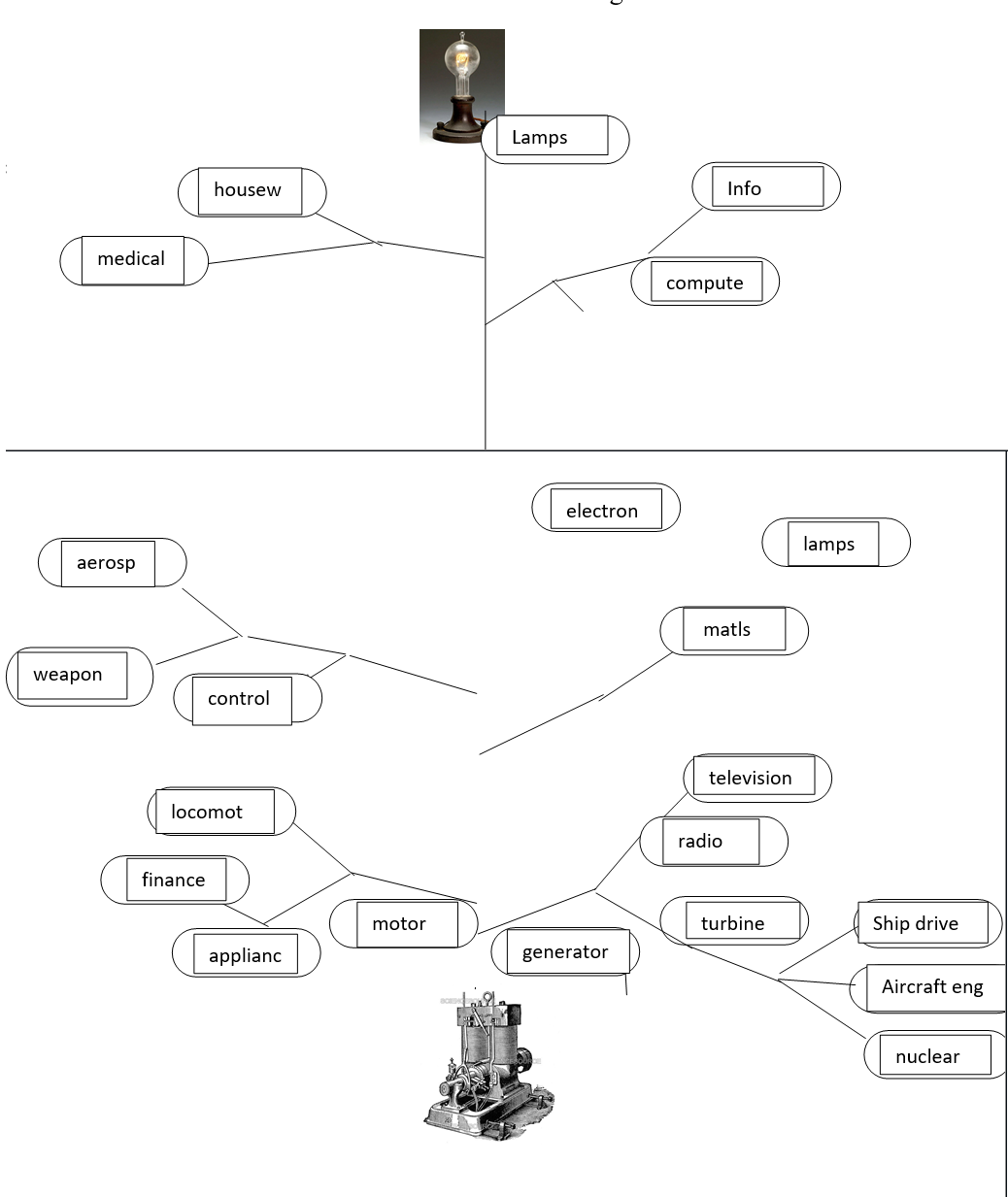
Much of the branching of the Elm is unsurprising. Making generators led to making turbines to power the generators, and later to nuclear reactors to provide steam for the turbines. GE initially made advanced materials to provide insulation, keeping electrons on the wires that carried electric power from the dynamo to the light bulb. Other branchings, however, are surprising. Generators provided GE's entry into radio, since a high speed alternator (a type of generator) briefly proved to be the best way to produce the radio waves that carried radio signals. GE's financial businesses branched off the appliance business, helping customers buy GE's relatively expensive refrigerator. GE's Medical businesses grew out of the light bulb, as William Coolidge put his light bulb improvements to work to make a better X-ray tube.
Turn now to the more general issue of what light the story of the Old GE might cast on the 20th Century's economic, business, and political history. Begin with the still dominant Chandler interpretation of Giant Corporation emergence. The Old GE's story supports Chandler's virtual inevitability interpretation. Certain technology-dependent industries were exceptionally well positioned to take advantage in the 1890s of economies of scale and scope. As Chandler pointed out, this happened not just in the U.S., but also in Britain, France Germany, and, later, Japan — all countries with very different political economy systems than the U.S. The rest of Chandler's alleged drivers, however — professional management, strategy, and the Visible Hand — get at best equivocal support from the story of the Old GE. It was no technically trained college graduate, but old shoemaker Charles Coffin, who established the tactics to which the company largely stuck.
Strategy later emerged as a bureaucratic exercise with little corporate benefit. The Visible Hand of top management produced such exercises in bluster as the cult of the professional manager who could run a pickle factory or a research lab, the "7-20 club" emphasis on short range profits, and Boulwarism. Meanwhile, such practices as price fixing managed to remain invisible to those Visible Hand professional managers.
GE's exceptional degree of diversification was rarely strategized from the top. Instead, it either welled up from the middle layers, or was brought in from outside. Sometimes the source was an independent inventor (e.g., Reginald Fessenden), sometimes it was a government initiative (e.g.,accepting Great Britain's generous offer of the Whittle jet engine), sometimes a new use for skills needed for an electrical product (e.g., moving from electrical insulation into engineering polymers), sometimes responding to the action of new competitors (e.g., CAT scanning and MRI). These diversifications were best managed not by Chandler or Cordiner style professional managers, but by leaders such as Charlie Reed, Gerhard Neumann, Lou Rader, and Glenn Warren. They combined knowledge about the technologies they managed, a willingness to listen, and skepticism of company professional management dogma.
In growing to giant size the Old GE's strengths were neither exceptional efficiency, low cost, nor, despite its pioneering research laboratory, discovery and invention. Instead its main strengths emerged as a participant in collective episodes of innovation. One strength was the capability quickly to assemble teams of diverse specialists. Another was to recognize and overcome dislocations of scale. Early examples drawing on those strengths included steam turbines, improvement of the tungsten filament for the incandescent lamp, the gas filled lamp, the Coolidge X-ray tube, and the domestic version of the Audiffren hermetically sealed refrigerator. Later examples included aircraft engines, silicones, plastics, diamonds, diesel electric locomotives, CAT scanners and MRI machines.
The Old GE story can also illuminate those issues that did not interest Chandler. These include the impact of a Giant Corporation on workers, customers, communities, and citizens. Towards workers, the story included, but was more complicated than, mere anti-unionism . Even before there was a GE, there was an Edisonian flight to Schenectady to escape unions. At Schenectady, GE sometimes battled with unions it dubbed (or slandered) as radical or communist, such as the 1906 IWW, the 1919 attempt to form a company wide industrial union, or the 1950 UE. These episodes alternated, however, with pragmatic labor peace, such as in 1905-1919 acceptance of AF of L craft unions and the 1936-1945 acceptance of that UE. Even during the 1960s heyday of that most arrogant of the company's labor policies, Boulwarism, GE delivered wages and benefits not all that different from those delivered by more conventional collective bargaining.
In their turn, the workers exhibited neither consistent radicalism, nor consistent conformity. Instead they could, as the occasion warranted, alternate between the two. Prominent examples included Martin Clune, who swung from ordinary metal polisher and Republican Party stalwart to socialist and IWW organizer, and then back to foreman and War Bond sales committee member; Charles Noonan, who went from IWW stalwart to GE foreman and then back to head of the Socialist Local Schenectady; Bill Turnbull, labor organizer, sewer socialist and also long time GE turbine inspector and first worker board member of the GE Employees Security Investment Fund; and Leo Jandreau, typical GE sklled worker of the 1920s, most likely a communist in the 1930s, and by the 1950s the non-ideological bargaining agent of IUE Local 301, totally devoted to the welfare of the workers. More generally, GE workers could vote socialist in 1911 without ever registering for the Socialist Party, follow their coworkers out on strike in 1913 or 1915 without carrying a union card, and, in the now legendary strike of 1946, show solidarity not so much for industrial democracy as for two bucks a day. Perhaps for many, membership in a union meant only as much, or as little, as membership in GE's Quarter Century Club.
Paricularly tuned to those ambiguous worker attitudes was the coordinated cooperation labor policy of the 1920s. One might dismiss it as mere hypocrisy. To that, a defender might reply that hypocrisy is the tribute that vice pays to virtue. Perhaps the hypocrisy of coordinated cooperation helped prepare Gerard Swope to later adopt a more constructive approach toward workers. His constructive acceptance of the Wagner Act was GE management's finest hour.
Toward customers, GE showed many faces, appropriate to the many types. In selling to electric utilities, the main customers numbered only in the hundreds. Many were engineers, some trained in the GE Test Program. The main Industrial Equipment customers also tended to be also relatively few, mainly oligopolists in such industries as oil, autos, and steel. Defense products has essentially one customer, the Federal government. Only consumer products competed for the millions of ordinary customers. It was in light bulbs, the largest market and the one with broadest cross section of customers, that GE made by far its largest profits, and did the most to limit competition, first by antitrust violation, then by patent monopoly.
More generally however, the Old GE was for most of the 20th century constrained to seek more moderate profits. This was not altruism. The constraints came from customer preference, the threat of government antitrust prosecution, depression, war, cold war, public opinion, and the complexities of technology. As a result of this constrained selfishness, the social rate of return on most of GE's businesses matched or exceeded the company's own private rate of return. Even that most monopolistic business, Lighting, provided such high social returns that lighting products were used by economist William Nordhaus to illustrate the high social benefit of technology-driven productivity. (617)
Towards communities, policies varied from benefit to bullying. The Old GE's role in its largest company community, Schenectady, NY, puts the 1980s deindustrialization episode with which this book began into perspective. Far from a surprise departure, that episode was a predictable extrapolation of the century long bell curve of typical U.S. 20th Century Giant Corporation presence. That curve began in 1886 when the Edison Machine Works arrived in Schenectady on the run from New York City's crowding, politics, and unions. It peaked in 1945-1950, as GE began moving to small locations in the South and West, on the run from Schenectady's crowding, politics and unions. The 1980s only extrapolated the curve. The only real surprise is that the Schenectady curve did not go to zero in the first decade of the 21st century, but leveled off at about 2000.
In between those end points, on the local scale, the Old GE alternately boosted and bullied the community that it had turned into the Electric City. The bullying included about a half dozen threats of departure. Episodes that included such threats ranged from the Kruesi Avenue purchase of the 1890s to the Make Schenectady Competitive campaign of the 1960s.
As that century of impact played out, Schenectady families, as illustrated in this book by the Clunes, Cermaks, Nigrinys, Gabrieles, Emspaks, Jandreaus, Manginos, Sarnackis, Schwenkers and Wellers achieved three generations of upward economic and social mobility. Atypical, but illustrating the possibilities, were the Wellers. The first GE Weller, Jake, crossed the Mohawk River in 1888 to join the Edison Machine Works as a laborer. He became a tool and die maker, and stayed for 43 years. His son and three grandsons all graduated from the Apprentice Program, carrying the family deep into the 20th century. From there, two more Apprentice graduates, Jacob's great grandson Keith and great granddaughter Kristie, brought the tradition into the 21st century, rounding off the family's total of 225 years of General Electric employment. (618)
Descendants of these long time families had by the late 20th century moved beyond GE to other professions or enterprises in the vicinity of Schenectady or beyond. Those descendants include Esther Schwenker, head of the Board of the Schenectady Library. Dr. James J. Nigriny, a graduate Union College and Albany Medical School practicing medicine in the Capital Region, Raymond Sarnacki, also a college graduate, spending 40 years in the non-GE corporate world, then becoming a citizen-scientist in archaeology for the Smithsonian. Gabriele descendants still run Gabriel's Market in Rotterdam, NY. Clune descendants still run the Clune Electrical Supply company in Clifton Park, NY. Descendants of Raffaele Mangino who arrived in Schenectady just after 1900 now run a Buick-GMC auto sales business in nearby Ballston Spa, NY. The professions of the Cermaks ranged from newspaper reporter to psychologist. Ruth Young Jandreau was in 1986 a leader of many Schenectady County public causes. On the national scene, Frank Emspak, son of Julius, detailed, in a 2022 memoir entitled Troublemaker, his own career as a shop worker, labor organizer, and historian.
For latecomers to Schenectady, however, that deindustrialization was a greater injustice. The growth takeoff of Schenectady's Black community, from 1945 through 1990, coincided with GE's accelerating departure. With it departed the opportunities that had previously been enjoyed by those previous waves of arrivals from Europe. That GE departure from Schenectady, did however, bring some equal racial opportunity to GE destinations such as Louisville, KY, Lynchburg, VA, and Columbia, SC. One way of summarizing this mixed messages of community impact might be that aphorism attributed to economist Joan Robinson. The only thing worse than being exploited by the capitalists is not being exploited by the capitalists.
As national corporate citizen, GE also mixed good and bad. Bursts of good corporate citizenship included the progressive initiatives of 1912 to 1929. such as pensions, life insurance, housing assistance, and unemployment insurance; calm and constructive acceptance of unionization in the 1930s and of civil rights in the 1950s; and service as an arsenal of democracy, helping to win two hot wars, and providing capability that helped deter a cold one from becoming hot.
Bursts of bad corporate citizenship included antitrust violations such as the pre-1911 lighting cartel, misuse of the patents such as the GE-Westinghouse Patent Board and the semantic exaggerations of "Greco-Schenectady" patentability, Boulwarism, the 1950s firing of employees for exercising their constitutional rights, price fixing, the mess left at Hanford, WA, and the million pounds of PCBs poured into the Hudson and Housatonic Rivers.
Other a aspects of GE citizenship are harder to grade. For example, should GE's role in the political emergence of Ronald Reagan count as good or as bad corporate citizenship? Reagan's 10 year GE career was certainly a key turning point not only in his life, but also in national politics. The interpretation, however, that GE leaders Cordiner and Boulware groomed Reagan as a sort of Big Myth Manchurian Candidate goes far beyond the available evidence.
In the end, final judgment of GE as corporate citizen is not just a matter of historical evidence, but also a value judgment. Here is one possible such judgment. Over the Old GE's century, the company's faults did not stop its products from getting better, its wage rates from increasing, its working conditions from getting less exhausting and more safe, its work force families from getting better educated, more diverse,and generationally upwardly mobile, and its technological achievements from helping to make lives longer, healthier, safer, more comfortable and more convenient.
The Old GE sometimes did all these things in ways that have justly been criticized. It did so, however, without imposing the full democracy-destroying plutocracy that is depicted in the more extreme Giant Corporation caricatures. In sum, when observing that the Old GE could have done a lot better as a corporate citizen, remember that it also could have done a lot worse. Making profits that were sometines excessive but rarely outrageously obscene kept GE from doing more serious mischief. As the British writer Samuel Johnson put it back in the 18th Century: "men are rarely more harmlessly employed than when they are making money."
To follow up on that thought, go back to that old folk definition of a corporation as a giant immortal artificial person without an ass to kick and a soul to save. How well did that characterize the Old GE? Gigantic it was. Immortal it was not. And it was also not without a target for kicks. The kicks came in the many forms. They ranged in severity from negative publicity to marketplace setbacks to antitrust indictments to courtroom convictions. Sometimes GE learned from painful experience how to anticipate and avoid future kicks. This was especially true for antitrust. For example, after exploring violation of the Sherman Antitrust Act, and suffering a kick in 1911, GE came around to anticipating antitrust effects and preempting them. It did so for example by discarding Electric Bond and Share in the 1920s. On the other hand, its top managers either tacitly accepted or did not inquire into, GE's most blatant corporate crime, price fixing.
The need for, and the effectiveness of, government antitrust action remains a complicated and contested topic. Few of the 20th century Giant Corporations were broken up or even significantly hampered by antitrust prosecution. For the Old GE at least, however, repeated antitrust convictions did help install an atmosphere of anticipation and preemption that helped head off more serious violations. As economist George Stigler put it, "the ghost of Senator Sherman is an ex officio member of the board of directors of every large company." (619)
Finally, the Old GE indeed did not have a corporate soul. Its claim to have a unique corporate culture was an exaggerated and inadequate substitute. It treated a small minority, measured in hundreds or a few thousands, of its top management and technical leaders as a privileged aristocracy. It treated the great majority, first tens and then hundred and thousands of its employees as easily replaceable interchangeable parts.
GE was, however, composed of actual people, who did have souls. Perhaps those souls were too often silent. Even when speaking, they were only occasionally listened to. Too often, their voices were drowned out by the barely disguised contempt for democracy and lack of concern about equality that characterized GE's top management. GE in this regard could echo the poet Wisława Szymborska: "please forgive me, soul, for only having you now and then."
Now and then, however, such souls were heard. Hear them again, with your mind's ear. Hear the voices of the thousand GE women of 1915, leading the thousands of fellow strikers out of the Works, singing:
Put this in your bonnet
With eight hours on it
And don't mind what the bosses say
For when the fight is over
We'll all be in clover
We'll all work eight hours a day
Hear Bill Turnbull, at the depths of the Depression:
Will workers continue to stand by while a wage earner gets $15 a week compared to the company President's $1750 a week, even though he could only wear one suit of clothes and one pair of shoes at a time?
Hear Gerard Swope assert the right of workers to vote about their own representation:
This is America, and that is the way we do things here!
Hear Leo Jandreau, answering a red hunting congressman:
I am not an authority on foreign affairs… I am only a fellow who came from the shop, elected as an officer of the union, and try to do my job honestly.
Hear Helen Quirini, answering a corporate labor relations manager who disparaged women workers:
I answered him, Mr. so-and-so, you know, I have a three year old nephew who could do your job. Because all you do is say "no", and he could do that as well as you do. There was silence in the room, and I was never again afraid to take on anyone.
Finally, whatever you may think of his subdued form of socialism, or his cooperative form of capitalism, hear Charles Proteus Steinmetz:
Now, personally, I have no fault to find with existing society. It has given me everything I wanted. I have been successful professionally in engineering and have every reason to be personally satisfied, and the only criticism that I can make is that I would be far more satisfied with my advantages if I knew that everyone else could enjoy the same.
"I would be far more satisfied with my advantages if I knew that everyone else could enjoy the same." Not a radical battle cry, striking fear in the hearts of capitalists cowering in their corner offices. Not a charitable cry toward which those capitalists might be willing to sacrifice a significant share of their salaries, incentive compensation, stock options, or personal perks. Not a business-school justification of corporate giantism rivalling Chandler's Visible Hand.
Though none of the above, that clunky Steinmetz sentence does point toward this book's answer to its main question: Giant Corporations of the 20th century: curse or beautiful? Giant Corporations' managers were more harmlessly employed making money than they might have been in other efforts, such as politics. Their expressed devotion to progress was indeed hypocritical, but it was a tribute to the virtue of innovation. All this left stockholders, customers, workers, cities holding GE plants, the nation and the world, a little better off being exploited by capitalists than they would have been not being exploited by capitalists.
That compromised combination, neither curse nor beauty, did offer halting and incomplete glimpses of Steinmentz's vision. Wages never sufficiently rewarded labor's added value, but did fitfully approach adequacy. Benefits never constituted a full private safety net, but did participate in an incomplete but growing private-public safety net. Non-material advantages that Steinmetz valued — recognition, respect, mutuality, and actual rather than management coordinated cooperation — were glimpsed less often and less clearly. The Old GE never achieved results in these dimensions that would have, or should have, satisfied Steinmetz. The Old GE did, however, provide glimpses of the possibility that, in cooperation rather than conflict, capitalism and democracy might advance together toward Proteus' modest goal.
Notes
- Galloway, Scott. 2024. The Algebra of Wealth. Penguin. p. 164.
- Rulison, Larry. GE Vernova reports profits. Albany Times Union 25 July 2024. [SCPL card required]
- Albany Times Union 17 Nov 2023.
- O'Donnell, James and Crownhart, Casey. We did the math on AI's energy footprint. Here's the story you haven't heard. MIT Technology Review, May 20, 2025, Online.
- Nordhaus, William D. 1988. Do Real Output and Real Wage Measurements Capture Reality? The History of Lighting Suggests Not. [free PDF viewer required] Cowles Foundation Paper No. 957. Nordhaus, William D. 2004. Schumpeterian Profits in the American Economy. [free PDF viewer required] NBER Working Paper No. 10433, p. 1.
- Jacob I. Weller Family Records, MiSci. Works News 22 June 1925.
- Stigler, George. 1950. Monopoly and Oligopoly by Merger. American Economic Review. 40. 23-34. p. 32.